The Sassy Noodle

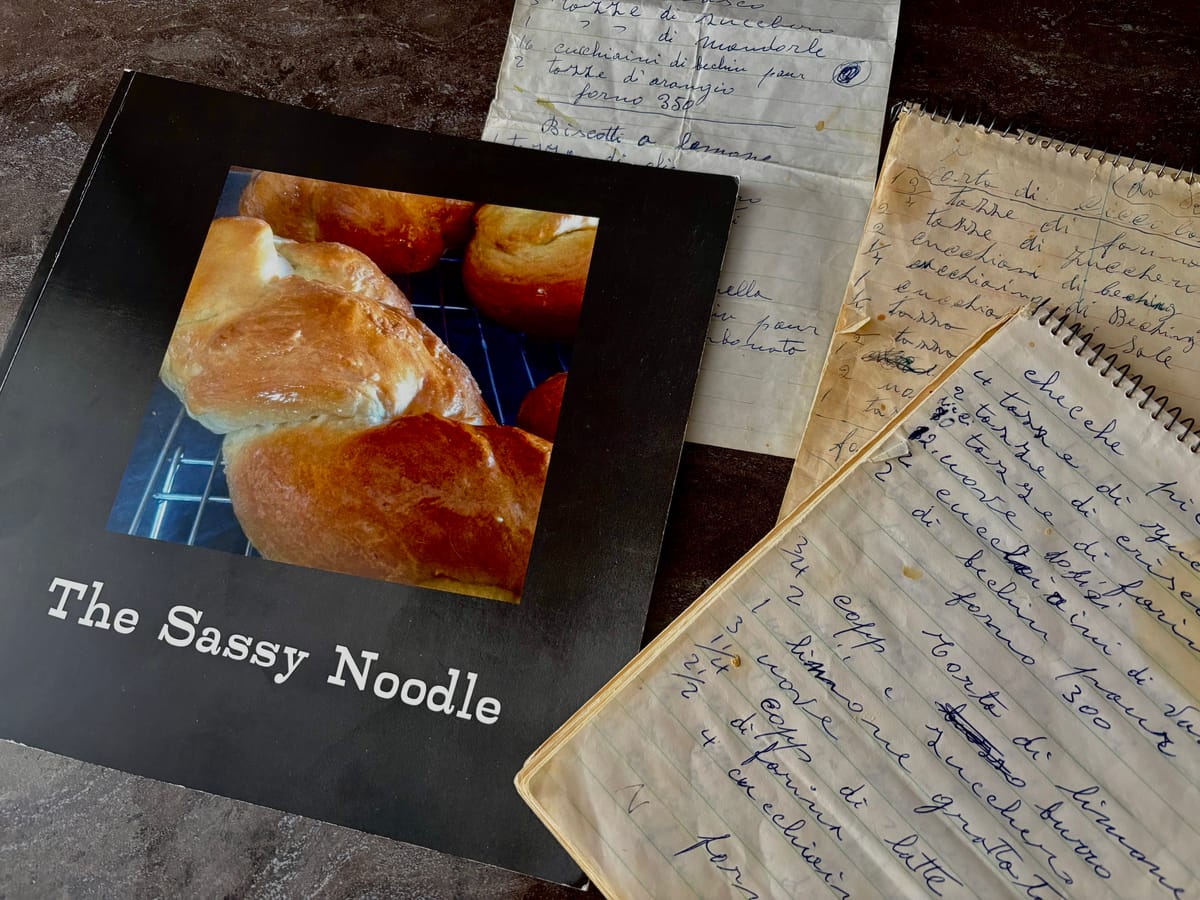
My family’s obsession with creating good homemade food is ingrained into our souls. And we go to great lengths to make sure people we love aren’t deprived of their favourites. Like the time I mailed my son an apple pie when he was away at school. Or the time my cousin insisted my son take one of her cheesecakes in his carry-on. Once I had a long chat with a Department of Agriculture agent at U.S. customs to ensure I could drive my dairy-free cannelloni across the border. Meghan, my lactose-intolerant daughter was in university in London, Ontario and our typical route took us through Michigan. Customs agents seized two trays of a friend’s lasagna on the same route once. I wasn’t taking any chances. When my daughter got engaged, I decided to honour this culinary love affair by surprising her with a collection of her favourite recipes, compiled into a professionally printed book.
The title of the book was the easy part. As a child, Meghan often said we should open a restaurant because such good food came out of our kitchen. We’d call it The Sassy Noodle. ”So you know running a restaurant is hard work,” I told her. “Will you be waiting tables and helping in the kitchen?” She looked at me with horror.
“No! We’ll hire people to do all that stuff. I’ll just get all dressed up and stand at the front doors when people come in,” she huffed. I guess this meant I was relegated to kitchen duty.
We never opened a restaurant but I thought the name could live on as a recipe book. My stash of unorganized recipes, stained from splashes of vanilla, cookie dough, and sweat, included old recipes I hadn’t made but other family members had perfected. I also had recipes in my head and I thought Meghan might care about those some day.
Her wedding date was set for New Year’s Eve. In March of the wedding year, I found an app to suit the purpose and started reaching out to family to let them in on the secret and request their contributions. My project management background kicked in and I created a timeline working back from the wedding day. I needed all content finalized by September, so I could complete the formatting by early October. This gave me enough time, padded with a bit of contingency, to have the book printed and shipped.
My family loved secret missions and they had a soft spot for Meghan so I knew they’d accept their assignments with gusto, adhere to my schedule, and heed my plea. “Take pictures, write down every step, and for goodness sakes measure your ingredients!” My children’s biggest complaint (and mine) was the absence of detail in some of the older recipes. I vowed not to perpetuate this practice.
I recruited Italians on my side of the family and Scottish/English cooks on my husband’s side. I wanted to attend all the secret baking events to document and supervise photo shoots but my chefs were scattered across the province. Even the local ones were like me and baked or cooked at all hours when they had a gap in their busy schedules. Because the timeline made it impractical for me to be present in their kitchens, I gave prescriptive instructions instead. I was fortunate my family loved and tolerated me.
Kitchens and chefs mobilized across the province. I looked through my mom’s old recipes and knew I’d have to attempt to bake some of this stuff to get photos and include actual instructions (her recipes were light on detail). I realized my children would never have a record of my mom’s handwriting. Or mine, for that matter. So I included photos of their late grandmother’s food-stained recipes written in her Italian scrawl, some in my messy English script, and even a recipe in my son’s childish handwriting.
My husband joined in and made his famous Shepherd’s Pie to represent his people. On one of her trips to Kingston, my cousin baked Mustazolle, the honey-flavoured diamond-shaped cookies of my youth, with her daughter. In the pictures they sent me, they were wearing aprons I made them from fabric we found in my mom’s house after she passed. It reminded me of my mother using my valentine cards to trace the heart-shaped pockets she loved to add to her aprons. Another cousin, our cheesecake queen, produced her delectable creations with very detailed instructions including tips, tricks, and encouragement like, “If it’s cracked, don’t sweat it. You get to cover it with blueberries.” This earned her a two-page spread.
I was fortunate to attend an Onion Frittata tutorial with my late uncle, at his beautiful cottage on Lake Superior. I watched as he tilted his ear toward the frying pan and declared with a solemn voice, “You have to listen for the onions to make the right sound before you add the flour and water.” I thought he was joking but the whole room paused while he and the onions had a moment. I wasn’t sure how to translate this into specific instructions, but his words became a mandatory part of the recipe.
Another highlight of the recipe-gathering task was making Shortbread Cookies with my late mother-in-law, who lived in Chatham. I always wanted to learn how to make those wee coins of melt-in-your-mouth heaven, but was intimidated by the pound of butter in them. She was of English descent but married a Scot and had perfected this family favourite. We planned the lesson for one of our trips to Chatham and she was ready for me. Butter purchased (it had to be Nielsen, left out on the counter the night before) and rolling pin ready, we started. Under her watchful eye, I mixed and kneaded the dough with a light touch. “You do the mixing. I go by feel and you’ll learn to do the same,” she said as I sunk my hands into the pillowy dough.
As I worked, she told me a story I’d never heard in the almost forty years I’d known her. “My mother-in-law brought this recipe over from Scotland but it never turned out for her like it did for me. I don’t think that made her very happy,” she whispered as she looked over her shoulder. It was as if the ghost of her late mother-in-law might appear in the kitchen and sour the dough. I got the impression it didn’t go over well that the English-bred daughter-in-law made the better Shortbread Cookies.
I learned how recipes and cooking styles can be divisive when one cousin gave me her recipe for Cudduri, the Italian deep fried potato doughnut typically made around Christmas. I’d tried them on my own with a recipe of unknown origin in my mom’s old pile and the result was dough that barely held it’s shape and produced deformed, tough blobs. My cousin told me her secret. “I don’t care what they say, I add an egg.” This was controversial and she warned me not to bring it up at our upcoming family reunion. “You might cause a scene,” she whispered.
As I collected ingredient lists, instructions, and photos, and tracked progress against plan, I found myself getting distracted by anecdotes connected to the recipes. I remembered my late mom’s friendship with our neighbour, whose famous Banana Cake was included in the book. She and my mom used to chat non-stop across the driveway from her side door to our kitchen window but I don’t ever remember them sitting down together for a cup of coffee in either of their kitchens. As I captured the process for making our traditional Italian Easter Bread, I found myself detouring into the story of old (egg in plain sight) and new (hide the egg in the dough) traditions surrounding this important cultural staple. The Easter Bread entry ended up occupying four pages in the book. Without realizing it, the recipes became secondary and the stories took up more and more space in my mind and in the pages of the book.
What started as a project with a strict schedule, a non-negotiable deadline, and bossy requests to family members across the province evolved into much more than recipes with precise measurements and instructions. For me, the Sassy Noodle was a journey of discovery about the chefs, their intense connection to their creations, and their love of feeding people. It was a trigger for childhood memories and a tribute to those who can no longer cook for us. I hope the recipes live on and new stories are born around them. And I hope new recipes foster new traditions that knit future generations together around their tables and in their kitchens.