A Gardner Not a Gardener

I used to kill hostas. I didn’t intend to murder plants, but I managed to kill even the supposed unkillable ones. I come from a line of fine gardeners but that didn’t help. My last name became “Gardner” when I married. That didn’t help, either. By the time August rolled around and my neighbour’s front yards were lush and adorned with pops of colour and happiness, my humble display was usually overgrown, undergrown, or had just grown tired and packed it in.
I was up against the unspoken assumption that when a woman settled down, she should enjoy and be competent at gardening. As if someone hit the activate button and peat moss, potting soil, and perennials became my new passion. I wasn’t equipped with that feature. I never understood the appeal of getting dirt on my hands. Dipping my hands into a vat of bread dough calmed my soul but soil was dirty. And garden gloves didn’t make a difference. I still knew what I was touching.
Nonetheless, I felt pressured by the odd looks I got when I said I couldn’t stand gardening. I spent hours in garden centres every spring attempting to choose plants that were easy to maintain, provided some colour, and worked for a north-facing house in the short Northern Ontario growing season. As if being allergic to gardening wasn’t enough, every home we lived in faced north and I quickly realized this limited my options. I held out hope I’d find a way to disguise my inadequacy as a gardener, albeit constrained by a house with inconvenient sun exposure.
My first hurdle was figuring out this part-sun/part-shade thing and determining how many hours of sun we got at the front of the house. I knew we didn’t get the morning sun, but eventually the sun did come around. But it was a gradual thing. It didn’t just pop in and pop out. When was I supposed to start and end the clock? It was like trying to understand a weather report. Was partly sunny the same as partly cloudy? In gardening speak, was part-sun and part-shade the same thing? It wasn’t helpful that the little sticks in the dirt pots at the garden centres were often covered with soil. Before I could decipher the sun/shade symbol and read other important details, I had to wipe it on something. That meant getting my hands dirty. While I was shopping.
I’d come home exhausted, defeated, and grimy. I greeted my husband with, “Our house faces the wrong way”, as if he could go outside right away and fix it. He looked at me and wondered if I’d inhaled too many fertilizer fumes.
It didn’t help that I was too intimidated to go to a proper nursery. Those professionals would sniff out a hosta-killer a mile away. And they spoke a different language. What if they asked me about the clay content of my soil? Instead, I went to grocery store or department store garden centres on weeknights when it was quiet. But students usually staffed the stores at this hour and their “must love gardening” switch was still off. I had many questions and even though they tried to be helpful, some of them couldn’t tell the difference between parsley and basil. Thanks to my Italian upbringing and love of the kitchen, even I knew that one.
One of the first homes we lived in after we got married was a semi-detached so I only had half a flower bed to worry about. We bought a miniature blue spruce that occupied most of the space and I planted some pretty roses that did all right. I hated weeding because it meant I had to get my hands dirty so I needed something to cover the rest of the flower bed and choke out the weeds. Periwinkle did the trick until it started taking over, strangling my roses, and jumping into the grass. We left that house over thirty years ago and all the subsequent owners are probably still cursing me.
Seven years later, we moved into a detached home in a new subdivision. We were one of the first houses on the street so I had a bit of a grace period while the neighbourhood established itself. But when the houses and the flower beds started popping up, I knew my gardening vacation was over. As if having a whole front yard to worry about wasn’t enough pressure, I heard a rumour that some incoming neighbours had won city beautification awards for their landscaping at former homes. I was doomed. Thankfully they moved in behind us (facing south, of course).
My search for low maintenance shade plants continued, even though every pretty bloom I was drawn to seemed reserved for sunny spots. People kept telling me to plant hostas but I held out for something with more colour.
“Anyone can grow hostas”, they said. “You can’t kill them”, they said. “They’re perfect shade plants”, they said.
I gave in. At least I’d get a few flowers out of them eventually. I planted hostas in the front yard under the shade of a maple tree and because I had too many, I planted the excess in the back yard in full sun. The ones in the sunshine thrived and flowered and the ones in the shade were just barely respectable. Some never flowered and eventually withered away. They were supposed to be shade plants. The plant labelling people needed to do better. To be fair, there’s only so much information you can get on a muddy little stick stuck in a pot.
There were times I almost gave up. It’s a good thing my husband ignored my frequent requests to mow down the flower beds and plant grass. He often accused me of not doing any jobs past the front doorknob because I didn’t shovel snow or mow the lawn. I did him a big favour. I killed hostas. Would he really want me messing with his healthy green lawn?
One spring, I decided containers overflowing with colour would draw the eye away from my pathetic-looking hostas. I bought a flat of vibrant red, yellow, and peach blooms and prepared my tools and pots in front of the garage. A neighbour, who spent hours in her stunning and manicured flower gardens, walked by. She stopped, looked at my containers, looked at the flat of annuals, looked at me, and said, “You’re going to plant all those flowers? In those containers?” I should have lied and said I had more pots in the garage. She was right, of course. I misjudged and ended up having to buy more containers. The next year, I bought fewer annuals and did my planting in the garage, with the door down.
In the meantime, I collected hosta-killers. When people talked gardening, I confessed my killing spree in the desperate hope of getting advice. I gathered some useful tips and some kindred hosta-killers. I was up to four of us at last count.
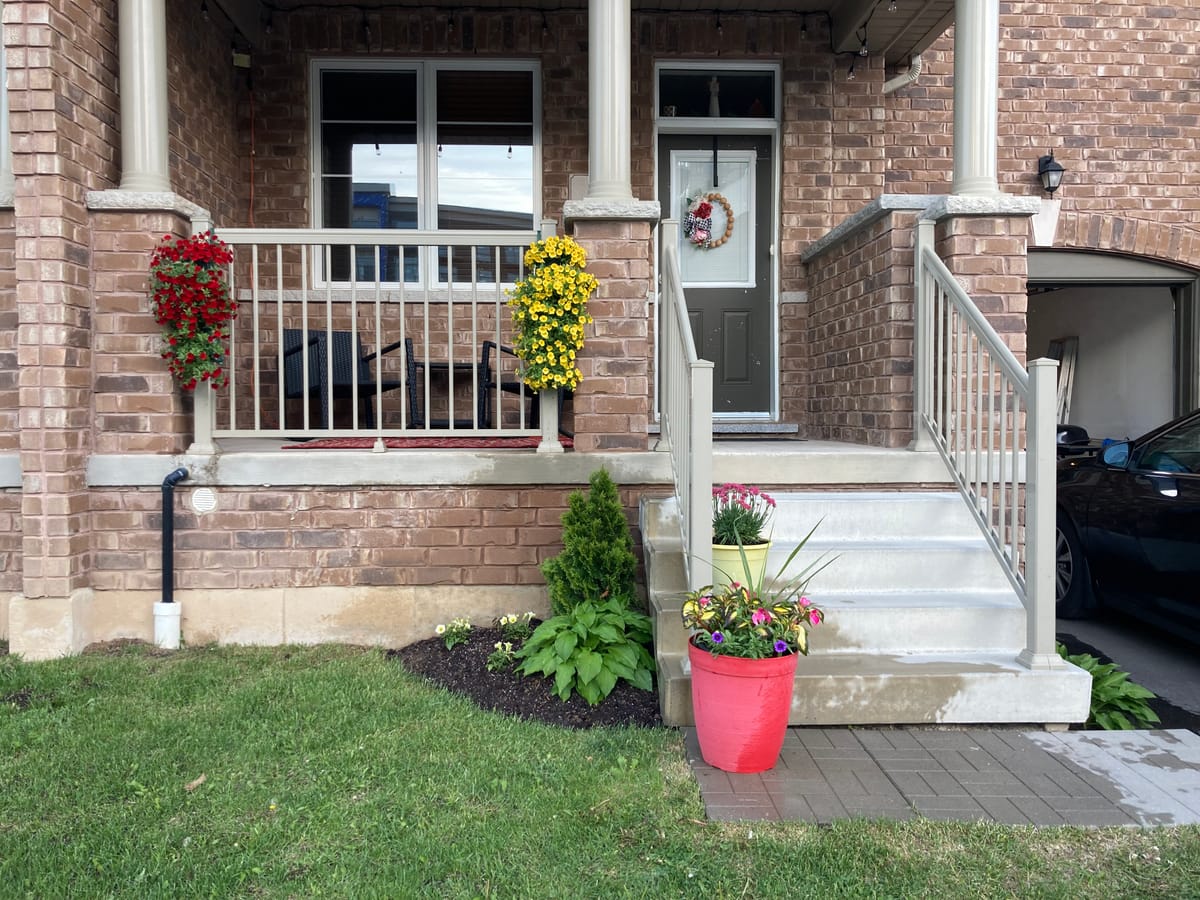
We now live in Southern Ontario, in a townhouse that faces north, with a tiny yard in front. A cedar tree, a few hostas (that I haven’t manage to kill yet), and some annuals occupy the small flower bed. A few containers (I buy them already made up) on the front steps finish off the look. Our neighbour works for a nearby large municipality and among many other things, is in charge of the gorgeous floral displays and lush greenery adorning medians, parks, and public buildings. She shares her expertise freely and my flowers love when we’re away and she takes over their care.
Even though our house still faces the wrong way, my reward for the hours, money, and dirty fingernails spent doing something I dislike, is a tiny front yard, a longer growing season, and a gardening expert next door. The universe landed me in the right spot.