Lessons from My Seam Ripper

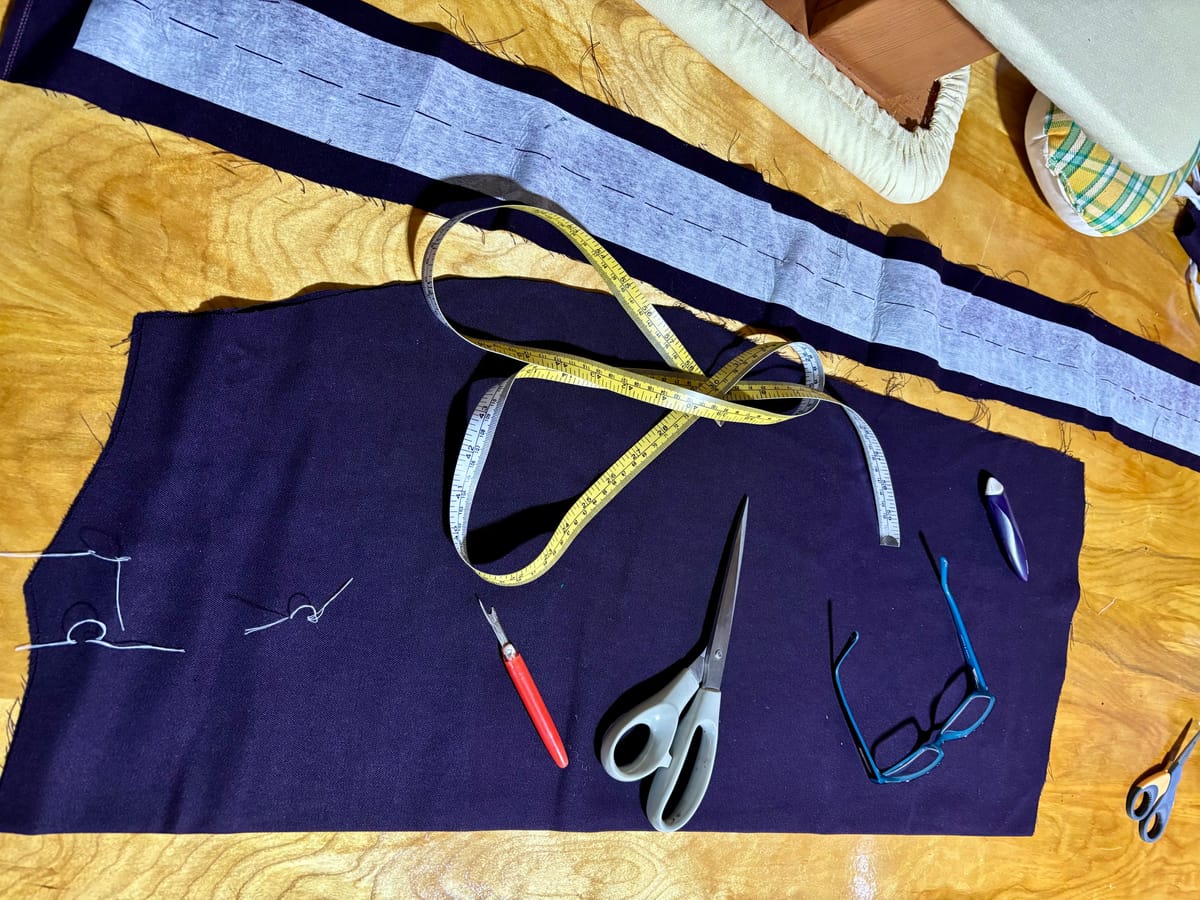
Sewing became a passion for me when I was working full-time, teaching part-time, and trying to keep up with a toddler. I ignored my fatigue and thought nothing of handling sharp objects late in the day after my son was hopefully tucked in for the night. But my mother, who lived next door, had an unsettling talent for seeing through my stifled yawns. She warned me that I was not superhuman and should be going to bed instead of sitting at my sewing machine until the wee hours. I should have listened.
Instead, I signed up for a tailoring course, determined to challenge myself with a complicated Vogue pattern for a fitted, lined blazer and skirt. The skirt was straightforward but the fitted jacket had bound buttonholes and princess seams running through welt pockets, techniques I had never attempted. I would be under the strict supervision of an experienced professional though, so what could go wrong?
I picked a gorgeous Scottish worsted wool fabric in a deep wine colour and looked forward to wearing it with pride. There were a lot of rules in tailoring. Our instructor insisted we use tailor’s tacks instead of a tracing wheel to transfer pattern markings to our fabric. This was so controversial that one of my classmates bailed and never finished the class. Seamstresses are a principled bunch. We were also taught the importance of rolling lapels instead of smashing them down flat with an iron. I was self-taught for the most part, so this was my opportunity to shed some bad habits. And I was working with expensive fabric so I told myself there was no room for my typical shortcuts.
The blazer came together well, with the welt pockets as the star attraction and the hand-rolled lapels complementing the princess seams. The simple lined skirt was next and was similar to others I’d made. I boasted to my mother that I cut the skirt out with such precision that I had fabric to spare. It was late when I sewed the center back lapped zipper into the basted seam. I could feel the effects of a long day as my neck muscles ached and my eyes blurred, but I was eager to wear the skirt with my waiting jacket. As I had done many times before, I inserted the tip of the seam ripper at the bottom of the zipper and started to rip the basting stitches out in an upward motion. To my dismay and utter horror, the seam ripper tore through the fabric about one inch to the right of the seam, leaving a large tear in the right back panel of my skirt.
In near hysterics, I confessed my horrible mishap to my husband, who reminded me, in an unhelpful manner, that I shouldn’t be sewing this late at night. It was what I needed to hear but not what I wanted to hear. I put my gutted, embarrassed, and frustrated self to bed, hoping a solution would come to me in the morning.
The next day, with no solution in mind, I confessed to my mother. I braced myself for a much deserved lecture, and prepared to admit she was right, a habit absent from my DNA when it came to my mother. Instead, she surprised me by remaining calm and non-judgmental and saying, “Didn’t you tell me you had extra fabric? Why can’t you just take the back of the skirt apart and cut out a new back right panel?” In my frenzied state, I hadn’t thought of this obvious solution.
My mother taught me I wasn’t superhuman but, when clear-headed, I could be resourceful. More importantly, she reminded me a little humility isn’t a bad thing and sharp objects had no place in my overtired hands. I continued to sew complicated garments long after she passed away, still pushing through when I was tired, but always checking in with myself and with her, before my scissors, seam ripper, or any other pointy tools, were invited to the table.