The Sears Silvertone Guitar

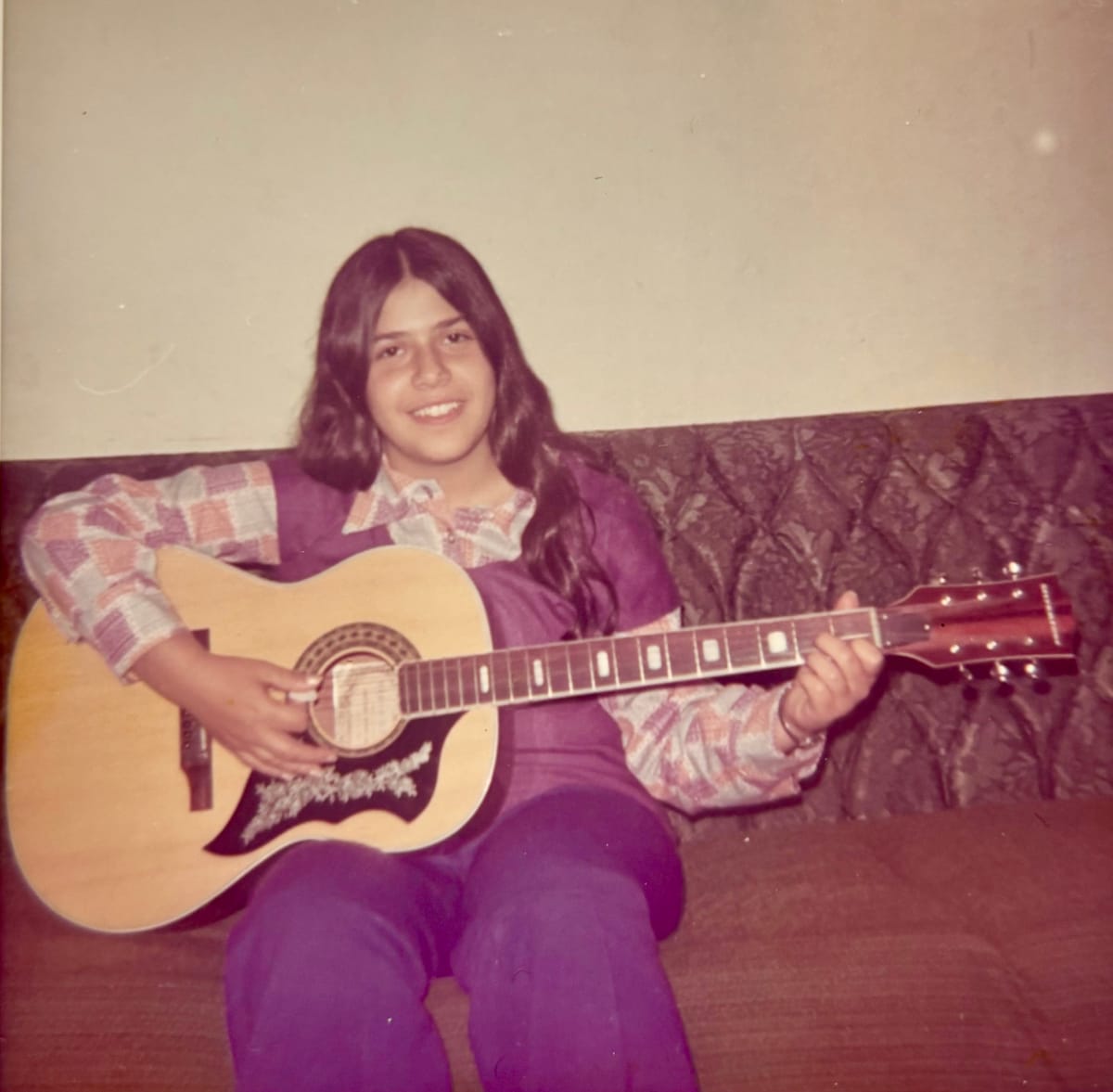
I wanted to learn how to play guitar so badly when I was eleven but the Italian kids took accordion lessons if they learned any instrument at all. And it was often only the boys who had the option of taking lessons. It was unfair. My brother had no interest in learning to play an instrument and my parents ignored my pleas. My grandfather heard me, which was odd because, even though he lived with us, I felt like he tolerated me at best. He had a crusty edge, wasn’t much for endearments, and groused and complained about everything, using profanity that sounded much worse in Italian. But when I was twelve, he bought me my first guitar, a $50 Silvertone acoustic from the Sears catalogue. Maybe he was tired of my grousing and complaining.
The Silvertone was my first love and best friend, even before I learned how to play it. The sound hole was adorned with a symmetrical pattern of circles and dashes and the black pick guard was etched with white vines and flowers. After subjecting my family to months of mindless plucking, my parents enrolled me in lessons. Sometimes I had to walk the twelve blocks to the music school, guitar case in hand, but it was worth it. I soaked up the finger placements, the theory, and the chords, and even though it was a group lesson, I felt like I belonged. The teacher was kind and patient, and I was apparently good at guitar.
I was a shy, introverted kid and my lack of confidence kept me inside my head, where I was safe and didn’t risk standing out. But music allowed me to express all the stuff I kept hidden, without fear of judgement. The Silvertone became an escape from my mother’s constant demands, my grandfather’s grumbling, and my feelings of inadequacy. I claimed the spare room as a music room and often retreated there when I was supposed to be helping with dishes or some other boring chore. My mother could never understand why my infatuation with the guitar came ahead of learning skills that would make me a good wife someday.
By the time I was fifteen, I discovered classical guitar, after hearing one of the older students play on a wide-necked, nylon-stringed beauty at a recital. I fell in love for the second time and that was the end of my acoustic guitar lessons. After saving up my babysitting money, I bought my beloved Giannini classical guitar and switched to private lessons. The Silvertone came out during sing-alongs with my cousins where nothing said “If I Had a Hammer” or “This Land is Your Land” like raucous chords on a cheap steel-string guitar. But for the emotional, haunting arpeggios of classical music, my Giannini took its place. I still couldn’t part with the old Sears special though, despite the fact it reminded me of my bad-tempered grandfather.
Years later, when my son Iain became a composer and moved to Toronto, I heard about a charitable organization in the GTA that was collecting old guitars for a wellness initiative. Iain knew the guy who ran the program. I thought about it for a while, wondering if I could part with the Silvertone that introduced me to playing and preserved my sanity during my early teenage years. I was torn but my practical side reminded me it was collecting dust, it came from a man I never liked, and the charity was sure to make good use of it (as long as the crabby grandfather vibes didn’t haunt its new home). With some reluctance, I said my goodbyes and gave it to Iain to give to his contact.
Next time I visited, the guitar was sitting in a stand in the corner of his apartment. Apparently, he played it from time to time and hadn’t gotten around to donating it. He had a few good guitars of his own by then so I wondered why he needed my $50 special.
Next time I visited, it was still there.
“Mom, I changed the strings!” I couldn’t understand why he was so excited.
“So the strings are worth more than the guitar. You know this, right?” I couldn’t help myself.
As if trying to convince me to take the guitar seriously, he played it for me and I had to admit, it never sounded so good. I was starting to wonder if it was destined to stay in the family. Once he got around to telling his charity contact about the guitar and its backstory, the guy said, “Are you sure you want to part with it?” It was the validation my son needed. The guitar wasn’t going anywhere.
A few years later, Iain was working on a project with a specific sound requirement and he wondered if my old guitar, which by then had a place of honour in his studio, might fit the bill. His fellow composers walked by his open door and stopped in wondering what type of guitar was making such a unique sound.
When he told me the story, I asked, “You mean, a tacky, tinny, $50 Sears special sound?”
“No, no, no,” he said, ignoring my sarcasm. “I needed a bona fide blue-grass sound for the score I was writing and nothing worked like the Silvertone. None of us could believe it.” I didn’t have the heart to dampen his enthusiasm.
After that, his colleagues often stopped by his studio to visit the guitar and take it for a spin, trying it out on their own projects.
So my grumpy grandfather’s gift lives on and the score Iain was working on made it to an adult animated series laced with profanity. How fitting.