The Wedding Dishes

As with most things my mother forced me to do when I was a teenager, I found a way to comply while ensuring I got my way or at least making sure she hadn’t gotten hers. A major concern for a traditional Italian mother of daughters was guaranteeing we were marriage-worthy and had a dowry. In addition to nightgowns that looked like they came from 1940’s lingerie catalogues, the bride was expected to come with wedding china. At sixteen, I couldn’t imagine anyone caring about this except for the mothers and their female contemporaries.
Worse, Italian girls – or their mothers – had to start constructing dowries early enough so they weren’t caught short. A woman might marry as young as 19 or 20 and it took years to amass a hope chest full of nightgowns, tablecloths, and doilies, preferably from the motherland. Every trip to Italy or to Little Italy in a big city was an opportunity to add to the stash.
“What do dishes have to do with anything?” I asked. “I’m sixteen. I don’t care about dishes.”
She was horrified.
“Why are we even talking about marriage? You said I can’t date unless it’s the man I’m going to marry. How will I know I want to marry him unless I’m allowed to date?”
My mother glared at me, rolled her eyes, and stalked off in a huff.
My complaining, my scowling, and my own eye-rolling (nothing to rival hers) got me nowhere. I gave in. My mom didn’t drive so my dad drove us to the china store. He brought his newspaper and waited in the car.
“Can I stay here with Daddy while you choose the dishes?“
My dad hid behind his newspaper while my mother aimed her dagger eyes at me.
As I gazed at the dainty pink and blue flowered dishes, I felt nothing but disdain for the stereotypical appropriateness of them all. My mother directed me to the traditional patterns laced with simple trims and I increased my distance from her and her choices. If they were at the top of her list, then they’d be at the bottom of mine. This defined my relationship with her during my teenage years.
After browsing for what seemed like an eternity, I knew the only way to end this painful experience was to settle on something. Ivory China was the newest thing according to the eager saleswoman who was giddy at the sight of an Italian momma walking into the store with teenage daughter in tow. I was used to translating for my mother but she took charge and didn’t let her limited English hold her back from closing the deal.
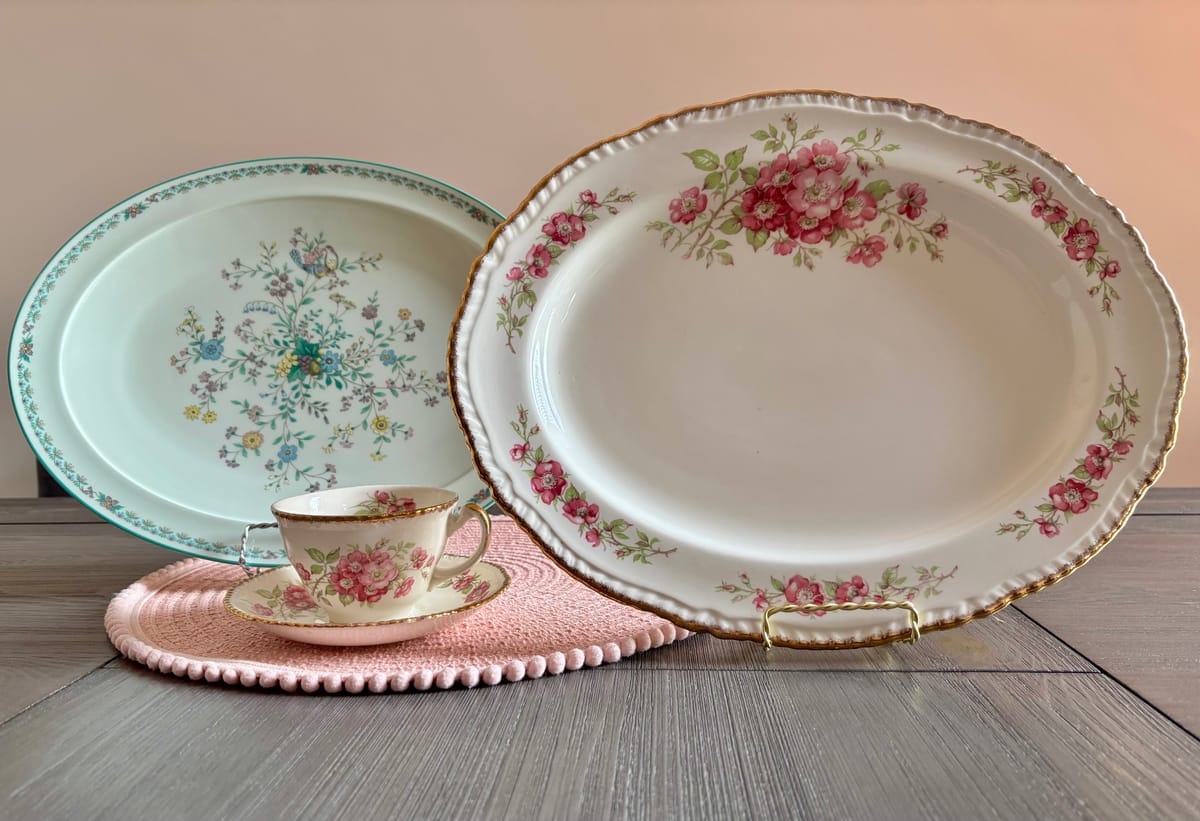
I poured over the Ivory China, most of which was not white. This was a good start. It came in pastel pink and light purple (my favourite colour) but I was drawn to the mint green dishes. I never liked green but it seemed the least offensive, most unique and less dainty pattern of all of them, if you didn’t count the birds and flowers that adorned the whole surface. Even though it was more expensive than the regular china, my mother was relieved I’d made a choice. Purchase made and mother happy, we exited with a few place settings to start me off. I had to work up to twelve place settings (eight would not do) and the completer pieces. The gravy boat, platters and coffee service set were the star attractions.
Since I hadn’t found the man I wanted to marry and subsequently date, I didn’t give the dishes much thought. My mother, however, was happy to share her wedding china enthusiasm with her friends. It accumulated behind my back and I faked excitement when my mother gifted me soup bowls at Christmas or a gravy boat on my birthday.
Then the crisis came. We received word that the pattern was being discontinued. This sent the Italian mommas to the china store in a panic. Gravy boat? I’ll take another in case one breaks. Platters? Better be safe and add one more. Pieces were shipped in from other cities to make sure nobody ended up with only eleven soup bowls, one short of a full set. The dowries could not be compromised.
Four years later, I did find a man I wanted to marry. He wasn’t Italian and had no interest in my dowry or my dishes but they were part of the package. I had all but forgotten about the green dishes until my mother hauled them out of the storage cubby. My first reaction was, Oh my goodness, they’re so green. My second thought was, This is what comes of letting a sixteen year old choose wedding china.
I reconciled with what was over a thousand dollars worth of fine china and set it up in my china cabinet for all to see. I dusted it all on a regular basis and only used it for special occasions. I tried to bring out my China when my mother and her friends came over, but oh no!
“Norma, not for us. This is your fine China!” (Like I didn’t know.) “Save them for a special occasion!”
Like a visit from the queen? I wondered.
So I used my second best tea cups and everyday dishes for their coffee and sweets. I was never sure which occasions were worthy of my good dishes. They didn’t come with a manual.
I tried to mirror my mother’s use of her own wedding china, a white set with pink flowers and gold trim, always on display in the china cabinet but never on the table. As time passed, I grew to love that set. When she died, I volunteered to take it and started using it when company came over.
When we moved to a smaller house I donated the green dishes, after trying to unload them on my kids and then in the classifieds, and packed my mother’s pink flowered dishes with care. One day, I found my nostalgic self searching for the pattern online and was excited to find a seller nearby.
I immediately forgot we’d downsized, decluttered, gotten rid of everything we didn’t need, and was halfway to my car before reality hit me. And still, it took all the willpower I could muster to not make that purchase.
Here I was, fifty years after being dragged to the china shop and turning my nose up at white dishes with pink flowers, having to restrain myself from buying white dishes with pink flowers. I hope my mother, wherever she is, is enjoying a great laugh at my expense. I deserve it.
Originally published in All Your Stories Magazine, April 2025 issue.